


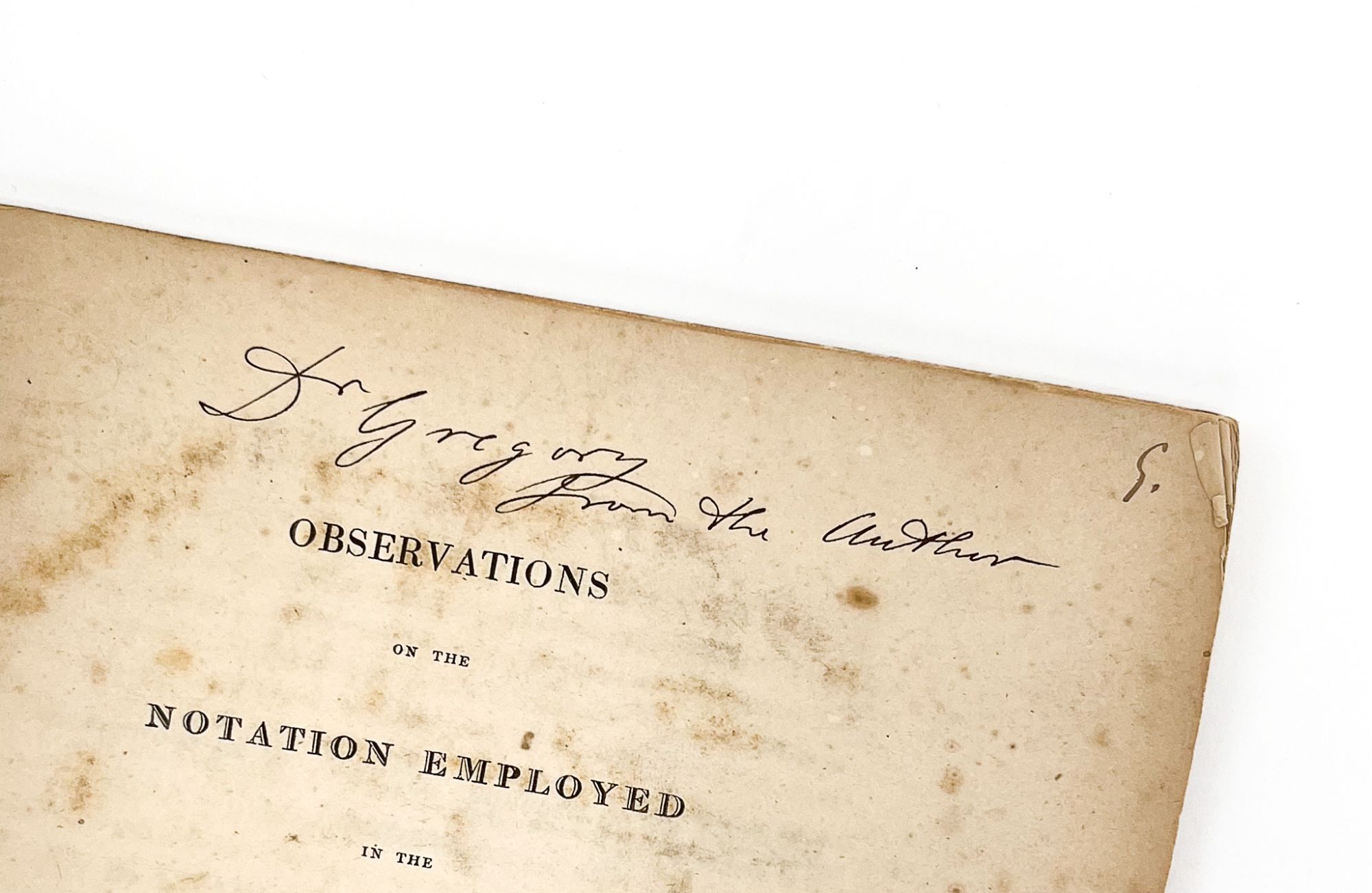

OBSERVATIONS ON THE NOTATION EMPLOYED IN THE CALCULUS OF FUNCTIONS
Presentation copy, inscribed to a mathematician and fellow co-founder of the Astronomical Society, of Babbage's major early-career paper on mathematical notation.
Very good.
Price: $18,000.00
OBSERVATIONS ON THE NOTATION EMPLOYED IN THE CALCULUS OF FUNCTIONS
"the calculus of functions [...] is the aspect of Babbage's mathematical work that modern mathematicians find the most fascinating" — John Michael Dubbey
Before Babbage invented the first mechanical computer, he had already distinguished himself as one of the most innovative mathematicians of his lifetime. "Observations" was "quite a remarkable paper," showing by unimpeachable mathematical calculations the reasons for his chosen system of notation for the calculus of functions. The notation of a mathematical theory is fundamental to its progress: without a usable system, the true potential of a theory remains by default unrealized. In other words, a great mathematical innovation cannot be great until it can be properly communicated through notation. In this paper, Babbage has put forth a compact and muscular system of notation for his biggest purely mathematical innovation, the calculus of functions.
This 1820 paper is bound in early wrappers with a few further Royal Society papers, including another foundational work in Babbage's early mathematical career, his 1815 "Essay Towards the Calculus of Functions [part I]." The calculus of functions was "undoubtedly Babbage's major mathematical invention" (Dubbey 51). While studying at Cambridge, Babbage realized that the patriotic dispute between Newton and Leibniz as contemporaneous inventors of calculus had led English education into staleness: Europeans continued to build on Leibniz's system of notations for calculus, while Cambridge mathematicians required rote memorization of Newton's work. Many of Babbage's earliest published mathematical treatises on the calculus of functions, including those here, not only brought the English approach up to date, but sought to innovate further in the field — essentially, the first substantive mathematical innovations by an Englishman since Newton. Babbage's calculus of functions, an area of mathematics he essentially invented, "has possibilities that have been little explored even in modern mathematics" (Dubbey 51).
The 1820 "Observations" was published the same year that Babbage, along with 13 others, founded the Astronomical Society of London (soon to be renamed the Royal Astronomical Society). Among its founding members was Babbage's friend Olinthus Gilbert Gregory, a professor of mathematics who was almost certainly the recipient of this presentation copy. Gregory and Babbage were part of the committee charged with developing the by-laws of the society the same year. It was, in fact, Babbage's activites with other Astronomical Society members that led to his first proposal to develop a difference engine for accomplishing large masses of calculations without error. When Babbage successfully constructed his first engine in 1823, the Astronomical Society presented him with a gold medal, and "this may have given him the encouragement he needed to go ahead with the task of constructing a much enlarged difference engine" (Dubbey 182). When Babbage sought government funding for what would be the first mechanical computer, Gregory wrote Babbage in full support of the idea: "The application of machinery to the purposes of computation, in the way you have so happily struck out [...] cannot fail" (quoted in Dubbey 183).
Presentation copies of Babbage papers are quite scarce, let alone examples from a formative time in his career — at the peak of his innovations for pure mathematics, and on the cusp of the world-changing mechanical ones that would earn him the nickname "father of the computer."
Read more: Dubbey, Mathematical Work of Charles Babbage; Collier and MacLachlan, Charles Babbage and the Engines of Perfection.
The Object
Cambridge: J. Smith, 1820, 1815. 11'' x 9''. Early drab paper wrappers. [2], 14; 389-454, [8] pages. Ink inscription, "Dr Gregory / from the author" to title page. Bound with: AN ESSAY TOWARDS THE CALCULUS OF FUNCTIONS 389-423 pages; A.P. Wilson Philip, SOME ADDITIONAL EXPERIMENTS AND OBSERVATIONS ON THE RELATION WHICH SUBSISTS BETWEEN THE NERVOUS AND SANGUIFEROUS SYSTEMS, 424-446 pages; errata 447; INDEX TO THE PHILOSOPHICAL TRANSACTIONS FOR THE YEAR 1815, [8] pages. Small shelf label to front corner of upper wrapper, pencil notation "1820"; some pencil annotations to margins, including mathematical calculations. Spine extensively repaired and reinforced with shallow chipping to fore-edges. Some browning and foxing to first imprint, else clean. Housed in custom quarter goatskin clamshell box.
The Fine Print
We work hard to meet our ethical responsibility to describe our material accurately. All items are guaranteed as described and may be returned for any reason within 30 days. Please notify us before mailing a return.
We guarantee the authenticity of our items. All materials are original (meaning not facsimiles or reproductions) unless otherwise noted. First editions (meaning first edition, first printing) are explicitly stated. TPM is a member of the Antiquarian Booksellers Association of America and upholds their Code of Ethics.
All photographs are of the actual item for sale. We're happy to provide additional images on request.
All domestic orders ship gratis. For orders under $250, free USPS media mail shipping is included; orders $250 and over ship USPS Ground Advantage. International orders over $1000 also ship gratis. Expedited, overnight, as well as other carriers (UPS, Fed-Ex, etc.), may carry additional costs beyond quoted rates. All orders receive tracking information and a direct contact in case of any questions.
International buyers are responsible for any customs, taxes, and related import fees. Please note that we are unable to accomodate requests to misrepresent, misdeclare, or otherwise falsify customs documents when shipping internationally. We appreciate your understanding.
We accept all major credit cards, Paypal, Venmo, check, money order, and bank wire. We are happy to bill institutional buyers' needs. Sales tax will be added to applicable purchases. Items subject to prior sale.
If for any reason you are dissatisfied with your purchase, please contact us. We prioritize our long-term relationships far above any individual purchase, and we want you to love your item as much as we loved cataloguing it.


